
The Scale of German Construction Procurement
Germany's construction industry is the largest in Europe, generating €391 billion in annual revenue 1 and accounting for a significant share of the country's economic output. With 346,688 construction companies and 62,179 engineering firms operating in the market,2 competition for public and private contracts is fierce. Public procurement alone represents a volume of €131 billion annually,3 encompassing everything from municipal road repairs to multi-billion-euro infrastructure programs.
The recently announced €500 billion infrastructure investment package 4 is set to intensify this competition further, creating a surge in tender activity across transportation, energy, and public building sectors. For construction firms of every size, the ability to identify, understand, and respond to tenders quickly and accurately has never been more important.
The Document Problem in Construction Tendering
Construction tenders are uniquely complex. A typical public construction tender comprises 200 to 500 pages 5 of technical specifications, contractual terms, pricing schedules, qualification requirements, and evaluation criteria. These documents are governed by a dense regulatory framework including VOB/A and VOB/B (the German Construction Contract Procedures), VgV (the Procurement Ordinance), and GWB (the Act Against Restraints of Competition).6
Minimum tender periods range from just 10 to 35 days depending on procedure type,7 leaving bid teams with very limited time to digest hundreds of pages, identify all requirements, coordinate with subcontractors, and prepare a compliant, competitive submission.
The consequences of inadequate document review are severe. The construction industry incurs an estimated €16.5 billion in annual error costs attributable to time pressure,8 and 80% of construction companies report experiencing miscommunication issues with subcontractors during the bidding and execution process.9 Many of these errors trace back to missed requirements, overlooked amendments, or misunderstood specifications in the original tender documents.
Regulatory Complexity Is Increasing
The regulatory landscape for construction procurement is not getting simpler. BIM (Building Information Modeling) is becoming mandatory for federal construction projects starting in 2025,10 adding new layers of digital requirements to tender specifications. The eForms-DE standard is now mandatory for electronic procurement notices,11 and new EU procurement thresholds take effect in 2026,12 changing the rules for which procedures apply to which contract values.
Each of these changes means that tender documents are becoming longer, more technically detailed, and harder to parse. A bid manager who could rely on experience and manual reading five years ago now faces a fundamentally different challenge — one where the sheer volume and complexity of documentation exceeds what human review alone can handle reliably.
Why Document Analysis Matters in Construction
In construction tendering, the documents are the bid. Every requirement buried in a technical specification, every deadline embedded in a procedural clause, every evaluation criterion hidden in an annex directly determines whether a bid will be compliant and competitive.
Consider what a typical infrastructure tender requires a bid team to extract:
- Technical requirements: Material specifications, performance standards, tolerances, testing procedures — often spread across multiple volumes and annexes.
- Qualification criteria: Turnover thresholds, reference project requirements, personnel qualifications, certifications — each one a potential exclusion risk if missed.
- Evaluation methodology: Price-quality weightings, scoring matrices, sub-criteria — understanding these determines bid strategy.
- Contractual terms: Penalty clauses, warranty periods, insurance requirements, payment schedules — overlooking any of these can turn a winning bid into a losing contract.
- Deadlines: Submission deadlines, clarification periods, execution milestones — missing a single date can mean automatic exclusion.
- Amendments: Changes between document versions issued during the tender period — these frequently alter critical requirements or deadlines.
Traditionally, this extraction process is manual. A senior estimator or bid manager reads the entire document set, highlights key passages, creates summary sheets, and briefs the team. For a 400-page tender, this process typically takes one to three full working days — time that could be spent on pricing, technical solutions, or quality improvements.
How Everwise Transforms Construction Tender Analysis
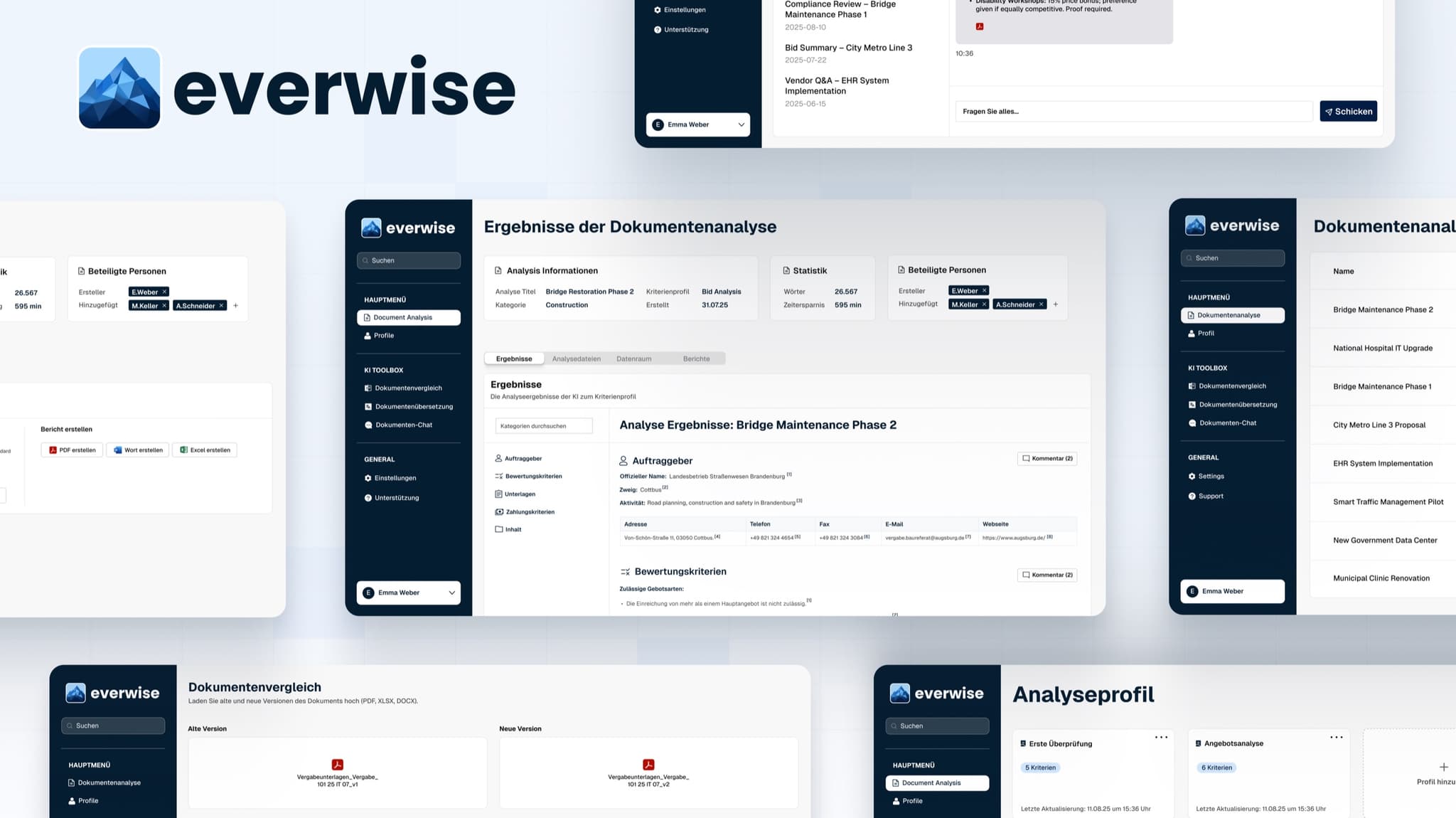
Everwise is an AI-powered document analysis platform designed to fundamentally accelerate how construction professionals engage with tender documents. Rather than replacing the expertise of experienced bid managers, it amplifies their capacity by handling the time-consuming document review process.
Intelligent Document Analysis
Upload your tender documents — PDFs, Word files, or scanned documents — and Everwise's AI engine analyzes them automatically. The system extracts requirements, deadlines, evaluation criteria, technical specifications, and contractual obligations, presenting them in a structured, searchable format. What previously took days of manual reading now takes minutes.
With customizable analysis profiles offering unlimited criteria tailored to construction-specific needs, you can configure the AI to focus on exactly what matters for your bid. Whether you are a general contractor looking at overall project requirements or a specialized subcontractor focused on specific technical lots, the analysis adapts to your perspective.
Chat with Your Tender Documents
Everwise's conversational interface lets you ask natural language questions about your uploaded tender documents and receive instant answers with direct source references. Instead of searching through hundreds of pages for a specific clause, you simply ask:
- "What are the qualification requirements for the project manager?"
- "What is the penalty rate for delays, and is there a cap?"
- "Which evaluation criteria have the highest weighting?"
- "What insurance coverage levels are required?"
Each answer includes the exact page and section reference, allowing you to verify the information immediately. This capability is particularly valuable during the bid preparation process, when team members across estimating, project management, and legal need quick access to specific information without re-reading the entire document set.
Document Comparison for Amendments
Amendments during the tender period are common in construction procurement. Contracting authorities frequently issue revised documents, additional annexes, or clarification responses that modify original requirements. Missing an amendment is one of the most common causes of non-compliant bids.
Everwise's document comparison feature highlights exactly what changed between document versions — added requirements, modified deadlines, revised specifications, or altered contractual terms. Instead of manually comparing two 300-page documents side by side, you get a clear, structured view of all changes within minutes.
Multilingual Capabilities
For construction firms working on cross-border EU tenders or projects involving international partners, Everwise provides document translation capabilities. Translate tender documents between languages while maintaining the technical precision that construction specifications demand.
Professional Reporting
Export your analysis results to PDF or Excel in your corporate design. Structured analysis reports support internal go/no-go decision meetings, subcontractor briefings, and bid review processes. Having a standardized, professional summary of every tender's key requirements improves communication across the bid team and reduces the risk of information being lost in handoffs.
The Competitive Advantage of Faster Document Understanding
In an industry where tender periods are measured in weeks and the cost of errors runs into billions,8 the speed and accuracy of document understanding directly impacts competitiveness. Construction firms using AI-powered document analysis gain advantages at every stage of the bid process:
- Faster go/no-go decisions: With key requirements, deadlines, and evaluation criteria extracted in minutes rather than days, management can make informed bid/no-bid decisions earlier, focusing resources on the most promising opportunities.
- More thorough requirement coverage: AI analysis catches requirements that human review under time pressure might miss, reducing the risk of non-compliant submissions.
- Better team coordination: Structured analysis outputs give every team member — from estimators to project managers to legal reviewers — access to the same clear picture of what the tender requires.
- More time for value-added work: When document reading takes minutes instead of days, bid teams can invest more time in competitive pricing, innovative technical solutions, and quality presentation.
Security and Compliance
Everwise understands the sensitivity of tender information. All documents are processed with 256-bit AES encryption, hosted exclusively in Germany, and handled in full compliance with GDPR requirements. Your tender documents are never used for model training, ensuring your competitive intelligence remains confidential.
Built for the Future of Construction Procurement
With the €500 billion infrastructure investment package 4 set to drive unprecedented tender volumes across Germany, the construction firms that will thrive are those that can process more opportunities, more accurately, in less time. Manual document review is a bottleneck that no amount of hiring can fully solve — the documents are simply too long, too complex, and arrive too frequently.
Everwise provides the document intelligence layer that modern construction bidding demands. By transforming how firms analyze, understand, and extract information from tender documents, it lets construction professionals do what they do best: build competitive bids and deliver great projects.