
IT Services Tenders Are Getting Larger and More Complex
Germany's IT services market continues to expand and is projected to reach €54.3 billion in 2026.1 At the same time, public IT procurement is increasing in both scale and procedural complexity. The federal central IT procurement body alone manages around €4 billion in planned annual procurement volume.2 In 2024, 58% of successful procurement procedures at the federal procurement office were above EU thresholds, and 98% of awarded volume was in above-threshold procedures.3
For IT service providers, this means more large tenders, more formal requirements, more annexes, and far more documentation that needs to be understood correctly within limited timelines.
The Real Challenge Lives Inside the Documents
IT services tenders rarely consist of a single requirements document. In practice, obligations are spread across the contract notice, statement of work, EVB-IT contract, pricing sheets, security annexes, data protection documents, and bidder Q&A responses. If your team reads only the main specification, it is easy to miss something commercially or legally critical.
Typical document packages include:
- Statements of work and requirement specifications with technical scope, delivery models, and staffing assumptions
- EVB-IT contracts defining acceptance, liability, penalties, and change procedures
- SLA and service-management annexes covering response times, availability, escalation paths, and support windows
- Security and data protection attachments for hosting, access control, subcontractors, incident handling, and audit duties
- Pricing sheets and award matrices that shape commercial strategy and evaluation weighting
- Amendments and bidder clarifications issued close to the submission deadline
Manual document review does not only consume time. It also increases the risk of missing mandatory requirements, award logic, or contract clauses that can materially change delivery risk and margin.
Regulation and Standards Keep Raising the Bar
Public procurement of IT services in Germany is governed by GWB, VgV, and UVgO.4 On top of that, EU-wide notices are now structured through eForms 5.6 That makes procedures more data-rich and more standardized, but not automatically easier to interpret. In many cases, teams must now reconcile even more fields, annexes, and change notices across the full document set.
The technical layer is just as demanding. In cloud, SaaS, and managed-service tenders, security and compliance obligations are becoming more detailed every year. The BSI C5:2020 framework alone covers 121 criteria across 17 topic areas.7 The German IT-Grundschutz Compendium remains a core reference point for organizational and technical controls.8 Since December 6, 2025, the German NIS-2 implementation framework has also become directly relevant for many organizations,9 increasing the likelihood that contracting authorities will ask for more detailed evidence and security commitments in tender documents.
For suppliers, that means success depends not only on capability, but on the precision with which they understand and answer security, operational, and governance requirements buried throughout the documentation.
Pricing Pressure Makes Better Document Analysis Even More Important
While documentation is getting more complex, economic pressure is rising as well. Destatis reported increasing producer prices for IT consulting and support, software development, and data processing and hosting in 2025.10 For bid teams, this means contractual obligations must be understood early and translated into pricing with much greater accuracy. A single overlooked SLA clause or hidden liability rule can turn a promising opportunity into a low-margin contract.
Why Traditional Review Processes Break Down
Many IT providers still rely on manual reading, spreadsheet summaries, and scattered internal review threads. That can work for smaller procedures. It does not scale well for public IT tenders involving multiple lots, security annexes, and repeated amendments.
Typical consequences include:
- Different departments read only the sections closest to their own role
- Contractual risk is discovered too late
- Changes between versions go unnoticed
- Bid/no-bid decisions take too long
- Teams spend too much time searching and too little time on solution design, pricing, and win strategy
How Everwise Speeds Up IT Services Tender Analysis
AI-Powered Document Analysis
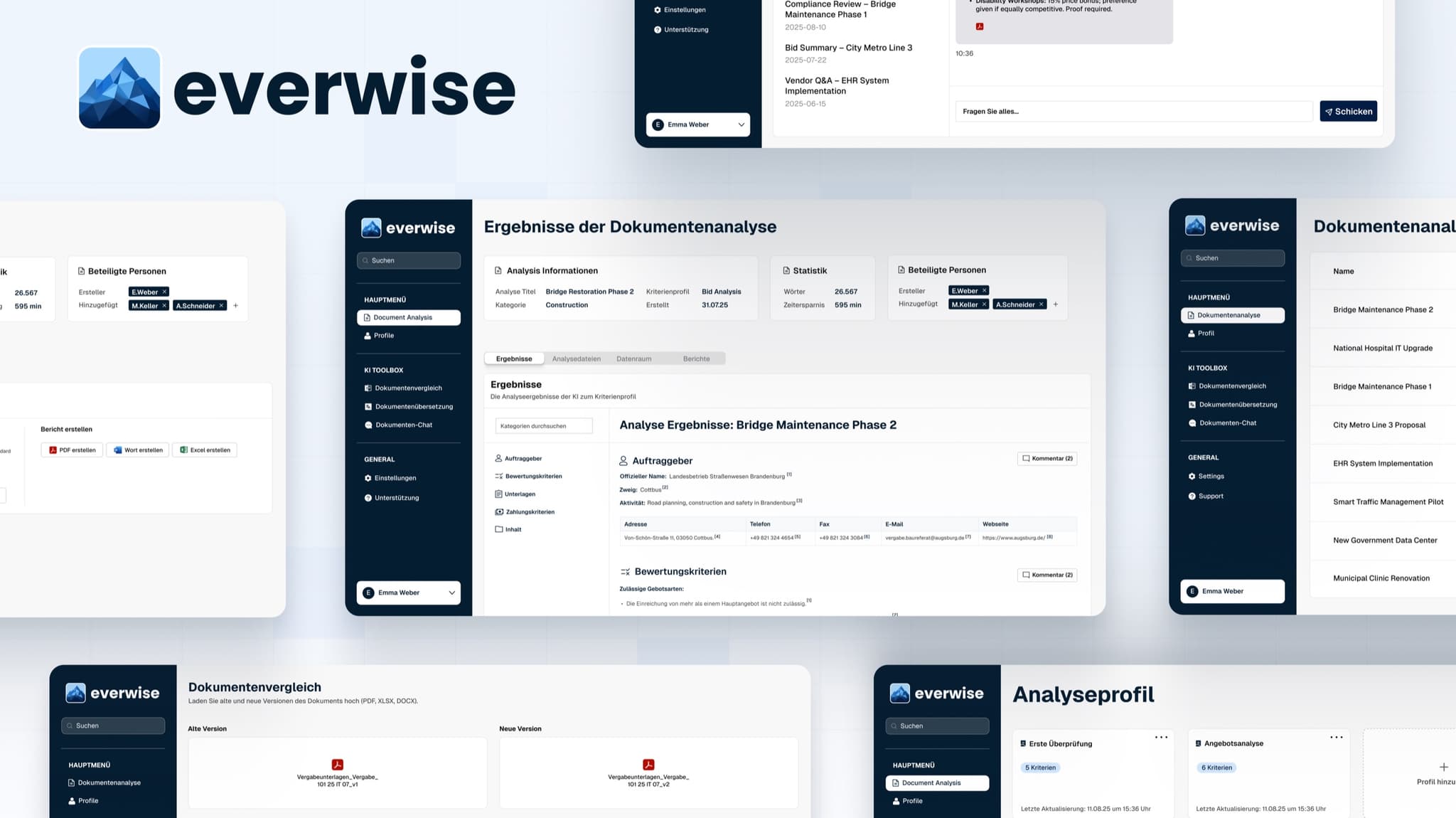
Everwise analyzes PDFs, Word files, and scanned tender documents automatically. The platform extracts deadlines, mandatory criteria, award logic, EVB-IT clauses, SLA obligations, and security requirements into a structured view. Instead of beginning with hundreds of pages of manual reading, your team starts with a usable analytical overview.
Chat with Tender Documents
After upload, your team can ask natural language questions such as: What response times apply in the incident process? Which qualification evidence is mandatory? What acceptance rules are defined in the EVB-IT contract? What hosting-location and subcontractor requirements appear in the security annexes?
Each answer links back to the relevant source passages in the original documents. That allows sales, delivery, security, and legal teams to work from the same source material without each person re-reading the full package.
Document Comparison for Amendments
IT procurement documents frequently change shortly before submission. Bidder questions are answered, scope wording is tightened, or contract annexes are updated. Everwise highlights exactly which requirements, deadlines, or contractual details changed, helping your team avoid working from outdated assumptions.
Structured Reports for Go/No-Go and Approval Workflows
Analysis results can be exported into structured reports that support internal decision meetings, legal reviews, and approval processes. Instead of circulating raw document sets, teams work from a single, traceable summary.
Typical Use Cases in IT Services
Managed services and service desk: Identify SLA obligations, escalation models, support windows, and staffing requirements quickly.
Cloud and hosting services: Extract C5, IT-Grundschutz, hosting-location, tenant-isolation, and subcontractor obligations reliably.
Software development and modernization: Consolidate functional requirements, migration duties, acceptance rules, and delivery organization across multiple files.
Cybersecurity and SOC services: Surface incident processes, reporting duties, response times, and security evidence requirements faster.
Security and Confidentiality
IT tenders regularly contain sensitive information on operating models, security architecture, access design, and pricing logic. Everwise is hosted in Germany, processes documents in compliance with GDPR, and encrypts all data with 256-bit AES encryption. Your documents are never used for AI model training.
Conclusion: Better Bids Start with Better Document Understanding
The core challenge in IT services tenders today is no longer simply obtaining the documents. It is understanding them accurately and fast enough across EVB-IT terms, SLAs, security requirements, eForms notices, and late-stage amendments.
Everwise helps IT service providers solve exactly that bottleneck: understand complex tender packages in minutes, identify risk earlier, and spend more time improving the quality of the bid.