
The German Healthcare Procurement Landscape
Germany's healthcare market is one of the largest in the world, valued at €435 billion and representing 11.5% of the country's GDP.1 Within this vast ecosystem, procurement is a critical function — hospitals, clinics, and healthcare organizations purchase everything from surgical instruments and diagnostic equipment to IT systems and facility management services through formal tender processes.
Government pharmaceutical purchases alone account for €56.5 billion,2 and the Hospital Future Act (KHZG) has allocated €4.3 billion specifically for hospital digitalization,3 creating a wave of technology procurement across Germany's hospital landscape. This funding, combined with the consolidation of group purchasing organizations (GPOs) — including mergers like AGKAMED and EKK Plus, Prospitalia and Sana, and Clinicpartner and PEG 4 — is reshaping how healthcare procurement operates at scale. Prospitalia alone serves over 900 hospitals,5 illustrating the concentrated purchasing power in the sector.
The Document Challenge in Healthcare Procurement
Healthcare procurement documents are uniquely demanding. A typical hospital tender for medical devices ranges from 100 to 300 pages,6 encompassing clinical specifications, technical requirements, regulatory compliance evidence, training and service obligations, evaluation criteria, and commercial terms. These documents are governed by a complex regulatory framework including GWB (Act Against Restraints of Competition), VgV (Procurement Ordinance), UVgO (Sub-threshold Procurement Regulation), the Medical Devices Regulation (MDR), and the German Social Code Book V (SGB V).7
The financial pressure on hospitals adds urgency to the procurement process. The German Hospital Federation (DKG) has reported that public hospitals are "at the edge of financial collapse",8 driving procurement teams to seek maximum value from every tender. For suppliers, this means procurement documents are becoming more detailed, evaluation criteria more rigorous, and compliance requirements more extensive.
Adding to the pressure, the KHZG imposes a 2% billing deduction from 2026 9 for hospitals that have not met their digitalization targets, creating a wave of time-sensitive technology tenders where both procuring entities and suppliers face compressed timelines.
Why Document Analysis Matters in Healthcare
Healthcare procurement sits at the intersection of clinical science, regulatory compliance, and public procurement law — making tender documents exceptionally dense and multidimensional. A single medical device tender may require a supplier to demonstrate:
- Clinical specifications: Product performance parameters, biocompatibility requirements, sterilization specifications, clinical evidence expectations — described in precise technical language.
- Regulatory compliance: MDR classification evidence, CE marking documentation, UDI requirements, vigilance reporting obligations — each with specific documentation demands.
- Service and training: Installation requirements, user training programs, maintenance schedules, response times for technical support — detailed in service level agreements.
- Quality assurance: Manufacturing quality systems, lot traceability, recall procedures, complaint handling processes — requiring evidence of certified management systems.
- Evaluation methodology: Multi-criteria scoring with weighted categories covering price, quality, clinical performance, service capability, and sustainability — understanding the exact weightings is essential for bid strategy.
- Commercial terms: Pricing structures, consignment models, payment terms, warranty obligations, liability frameworks — each with significant financial implications.
For a 250-page hospital tender, manually extracting and organizing all of this information typically requires two to four working days of senior staff time. In an industry where bid teams are often small and stretched across multiple concurrent tenders, this document review burden is a significant constraint on the number and quality of responses a supplier can deliver.
The Digitalization Wave in Healthcare Procurement
The KHZG funding program 3 has triggered an unprecedented volume of digital health tenders across Germany. Hospitals are procuring electronic patient records, clinical decision support systems, telemedicine platforms, and digital medication management — each requiring suppliers to respond to complex, multi-volume tender documents.
The GPO consolidation trend 4 is simultaneously changing the scale of procurement. When a purchasing organization serving 900+ hospitals 5 issues a tender for a product category, the document complexity reflects the need to accommodate diverse hospital types, sizes, and clinical requirements within a single procurement framework. These tenders are longer, more technically detailed, and more stringently evaluated than traditional single-hospital procurements.
For healthcare suppliers, the ability to quickly and accurately analyze these large-scale, complex procurement documents is becoming a fundamental competitive capability.
How Everwise Transforms Healthcare Tender Analysis
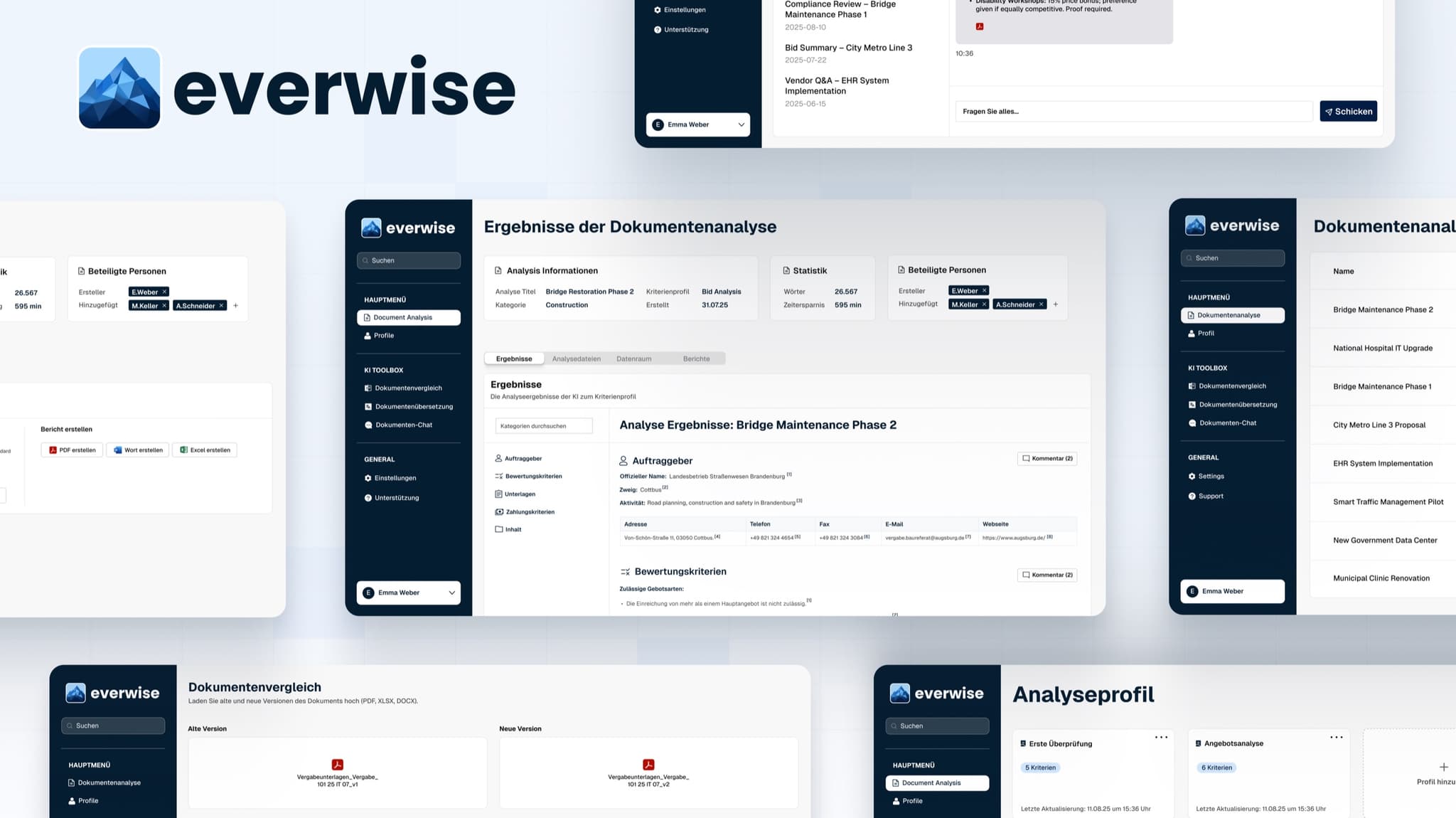
Everwise is an AI-powered document analysis platform designed to help healthcare suppliers engage with complex procurement documents far more efficiently. Rather than replacing clinical and regulatory expertise, it amplifies the capacity of bid teams by handling the time-intensive document review process.
Comprehensive Document Analysis
Upload your healthcare tender documents — whether they are PDFs, Word files, or multi-document packages — and Everwise's AI engine analyzes the complete content automatically. The system identifies and extracts clinical specifications, regulatory requirements, evaluation criteria, service obligations, and commercial terms, presenting them in a structured, navigable format.
With customizable analysis profiles offering unlimited criteria, you can tailor the AI to focus on what matters most for your specific product category. A medical device manufacturer can prioritize clinical and regulatory requirements; a healthcare IT provider can focus on integration specifications and data security criteria; a facility management company can emphasize service level expectations and staffing requirements.
Chat with Healthcare Tender Documents
Everwise's conversational interface is exceptionally powerful for healthcare procurement documents, where specific requirements are often buried deep within technical annexes or cross-referenced across multiple volumes. Ask natural language questions and receive instant, source-referenced answers:
- "What clinical evidence is required to demonstrate product efficacy?"
- "What are the required response times for on-site technical support?"
- "Summarize the evaluation criteria and their percentage weightings."
- "What data migration requirements does the IT system specification include?"
- "What training program documentation does the tender require?"
Every answer includes exact page and section references, enabling clinical specialists, regulatory affairs teams, and commercial leads to verify information immediately. This capability is particularly valuable in healthcare, where the interpretation of a clinical specification or regulatory requirement frequently requires expert judgment — Everwise finds the relevant passage instantly, and the expert evaluates it.
Amendment Tracking for Revised Tender Documents
Healthcare tenders frequently undergo revision during the submission period. Procuring entities may clarify clinical specifications, modify evaluation weightings, update regulatory requirements, or adjust service expectations. These amendments can be issued as revised documents, supplementary annexes, or clarification responses.
Everwise's document comparison feature identifies precisely what changed between versions, presenting a structured summary of all modifications. When a hospital group revises a 200-page medical device tender two weeks before the submission deadline, Everwise shows you exactly which specifications changed, which evaluation criteria were adjusted, and which deadlines were modified — in minutes rather than the hours or days required for manual comparison.
Multilingual Healthcare Document Processing
Healthcare procurement increasingly operates across borders, particularly for medical devices and pharmaceutical products marketed across the EU. Everwise's translation capabilities allow suppliers to process tender documents in different languages while maintaining the clinical and regulatory precision these documents demand.
Structured Reporting for Bid Decisions
Export analysis results to PDF or Excel in your corporate design. These structured reports support internal bid/no-bid decisions, cross-functional team briefings, and management reviews. In healthcare procurement, where bid decisions involve clinical, regulatory, commercial, and operational stakeholders, having a clear and standardized document summary accelerates alignment and improves decision quality.
The Competitive Advantage in Healthcare Procurement
In a healthcare market under severe financial pressure,8 procurement decisions are increasingly rigorous, and the quality of supplier responses is scrutinized more closely than ever. Suppliers that understand every requirement, address every evaluation criterion, and demonstrate comprehensive compliance gain a decisive edge.
AI-powered document analysis delivers this edge at every stage:
- Faster opportunity assessment: With key requirements and evaluation criteria extracted in minutes, bid teams can quickly determine whether an opportunity matches their product portfolio and competitive position.
- More thorough requirement coverage: AI analysis captures every specification, every regulatory reference, and every evaluation criterion across every page — eliminating the risk of missing a critical requirement in a 300-page tender.
- Better cross-functional collaboration: Structured analysis outputs give clinical specialists, regulatory affairs professionals, service managers, and commercial leads shared visibility into what the tender requires, enabling more coordinated and comprehensive responses.
- More time for response quality: When document analysis takes minutes instead of days, bid teams invest more time in developing clinically compelling evidence presentations, differentiated service proposals, and competitive pricing.
Security for Sensitive Healthcare Data
Everwise processes healthcare procurement documents with rigorous security measures. All documents are encrypted with 256-bit AES encryption, hosted exclusively in Germany, and handled in full GDPR compliance. Your documents are never used for AI model training, ensuring that your clinical evidence, pricing strategies, and competitive approaches remain completely confidential.
Meeting the Future of Healthcare Procurement
With the KHZG digitalization deadline approaching,9 GPO consolidation accelerating,4 and financial pressure on hospitals intensifying,8 the volume and complexity of healthcare procurement will continue to grow. The suppliers that will succeed are those that can respond to more tenders, with higher quality, in less time.
Everwise provides the document intelligence foundation that modern healthcare bidding requires. By transforming how suppliers analyze, understand, and extract information from complex procurement documents, it enables healthcare companies to compete more effectively — winning more contracts and ultimately contributing to better healthcare outcomes.