
Mobility Procurement Operates Under Growing Pressure
Germany's mobility market is heavily shaped by public funding and large-scale transformation programs. In the first half of 2025 alone, public transport in Germany recorded 5.7 billion passenger journeys, including 1.4 billion in local rail and 2.6 billion in local bus transport.1 In 2024, the federal government provided around €13.2 billion in regionalization funding for public transport and an additional €1 billion in GVFG funding for rail-based local transport.2 On the infrastructure side, DB InfraGO invested around €20.1 billion in 2024 in the expansion, renewal, and maintenance of tracks, stations, and energy infrastructure.3
These figures show how much procurement activity now sits behind public transport services, rolling stock, control systems, depots, and infrastructure-related projects. For suppliers and operators, the speed and quality of document analysis increasingly determines whether opportunities can be assessed correctly and bids can be submitted completely.
The Complexity Goes Beyond Procurement Law
Mobility tenders are rarely simple price competitions. A single procedure often combines legal, operational, technical, and data-related requirements. A transport contract may include duration, compensation, quality KPIs, penalty regimes, staffing obligations, transition rules, data-delivery requirements, and sustainability targets. Technical annexes define vehicle requirements, depot and charging infrastructure, control center interfaces, passenger information systems, or ITCS specifications.
Operational documents add another layer: timetables, start-up plans, disruption processes, migration scenarios, and personnel transfer obligations. If your team reviews these documents in isolation, it is easy to miss mandatory criteria hidden in annexes, tables, or later clarifications.
Regulation, Data Obligations, and Sector Procurement Increase the Workload
Several regulatory frameworks apply at once in mobility procurement. Many procurements by transport utilities and infrastructure operators fall under the German Sector Procurement Ordinance (SektVO).7 Public service contracts in local transport are also shaped by PBefG Section 8a and EU Regulation 1370/2007 5.8 Together, these rules influence procedure type, timelines, contract structure, and award logic.
Data obligations are becoming equally important. PBefG Section 3a requires providers and intermediaries to make static and dynamic mobility data available.5 Germany's Mobilithek serves as the national access point for mobility data.11 That means APIs, real-time data, fare information, and metadata obligations are increasingly part of the tender package itself. eForms and digital notices add more structure to procedures,6 but they also create more fields, more change notices, and more references that need to be reconciled across documents.
Technical standards also shape procurement requirements directly. Rail and infrastructure procedures may involve interoperability requirements such as ETCS or the CCS TSI.10 In German federal road projects, BIM is being rolled out as a standard process from 2025 onward.9 As a result, teams must increasingly deal with additional document types such as information requirements, execution plans, model standards, and coordinated data states.
Labor Shortages Make Faster Analysis Even More Valuable
The sector is operating under significant staffing pressure. Public transport companies represented in the VDV employ around 152,000 people, and the association projects that workforce needs will rise by around 21% by 2030 while roughly 20,000 bus drivers are already missing today.4 Even though those figures focus on operations, they underline the wider reality: transport organizations must plan, procure, and deliver more with limited capacity.
That is exactly why it is inefficient for specialists in operations, engineering, pricing, and legal to spend days manually searching through the same document sets. Every hour spent searching instead of evaluating slows go/no-go decisions, bid strategy, and internal coordination.
Why Manual Document Review Is Especially Risky Here
Mobility tenders often combine notices, service specifications, draft contracts, technical annexes, pricing sheets, timetable data, sustainability requirements, and later clarifications. Common risks include:
- KPIs and penalty regimes are defined in the contract, not the specification
- Staffing and transition obligations are distributed across multiple annexes
- Data and interface requirements are only fully described in technical attachments
- Amendments between bidder questions and final documents go unnoticed
- Operations, legal, engineering, and commercial teams read the same documents with different priorities
In large procedures, that quickly leads to incomplete assumptions or slow approval cycles.
How Everwise Accelerates Mobility Tender Analysis
AI-Powered Document Analysis
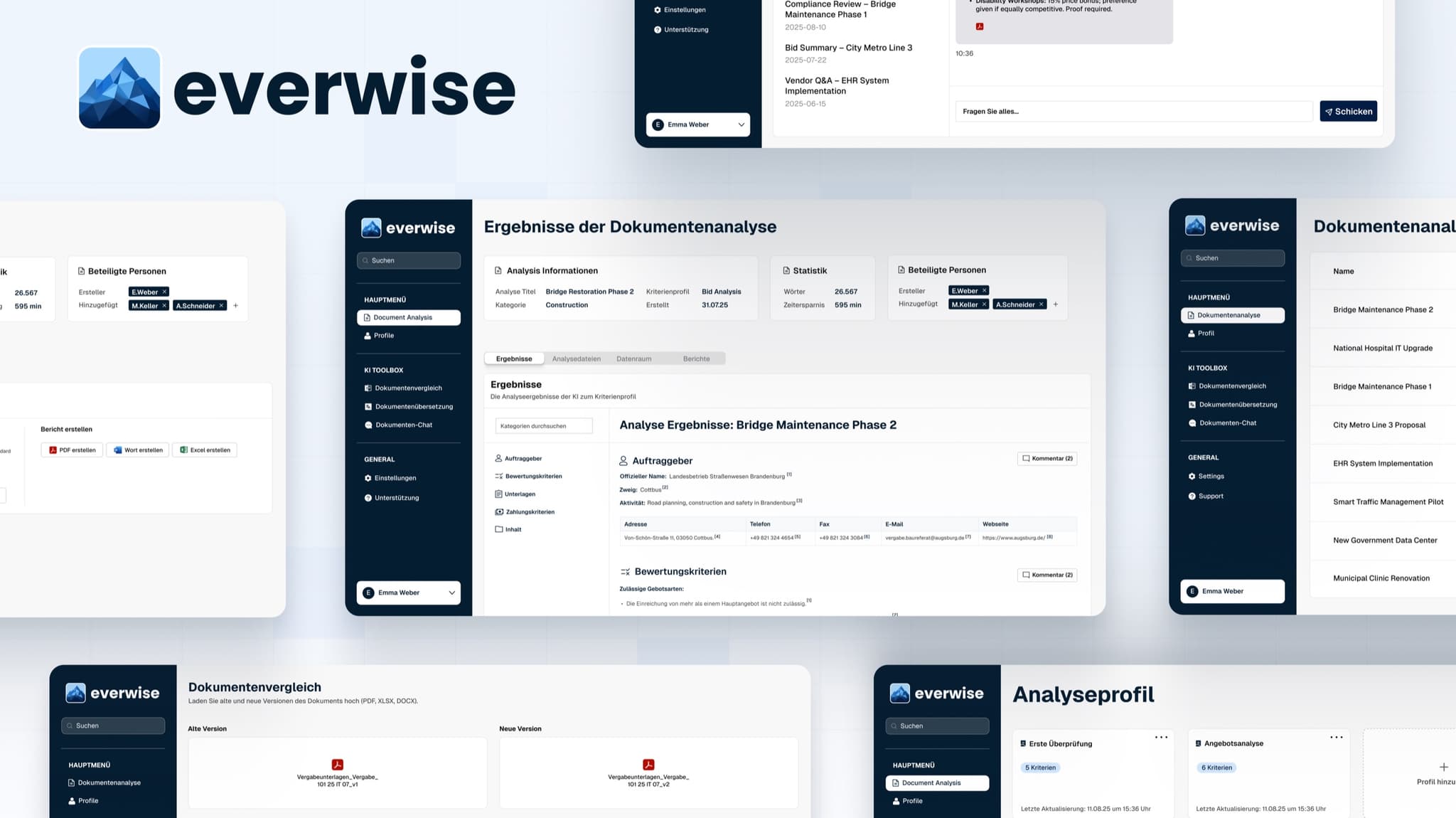
Everwise automatically analyzes transport contracts, technical specifications, pricing sheets, timetable documentation, and scanned tender packages. The platform extracts deadlines, award criteria, KPI obligations, operational requirements, data duties, and contractual risks into a structured overview.
Chat with Tender Documents and Transport Contracts
After analysis, teams can ask natural language questions such as: Which punctuality KPIs apply? What are the vehicle or charging infrastructure requirements? Which deadlines govern service start and staff transfer? Which mobility data must be delivered to the Mobilithek or other systems? That makes it easier for operations, engineering, sales, and legal to access the information they each need.
Document Comparison for Amendments
Mobility procurement documents frequently change between initial publication, bidder Q&A, and final contract versions. Everwise shows exactly which deadlines, route scopes, scoring matrices, technical parameters, or contract clauses changed, reducing the risk of working from outdated versions.
Structured Reports for Internal Alignment
Analysis results can be exported into reports that support go/no-go reviews, management discussions, and cross-functional coordination. Instead of working from disconnected spreadsheets and marked-up PDFs, teams can rely on one traceable summary of the tender package.
Typical Use Cases in Mobility Procurement
Public transport and regional rail tenders: Extract transport contract obligations, service levels, timetable assumptions, quality KPIs, and staffing duties faster.
Vehicle and depot procurement: Identify technical specifications, clean-vehicle requirements, and charging or workshop obligations reliably.
Mobility IT and passenger information: Consolidate API, real-time data, interface, and operational-data requirements from multiple annexes.
Infrastructure and planning projects: Analyze BIM, interoperability, and safety-related requirements across large document sets more efficiently.
Security and Confidentiality
Mobility tenders often contain sensitive information about networks, operations, fleets, IT architecture, pricing logic, and safety processes. Everwise is hosted in Germany, processes documents in compliance with GDPR, and encrypts all data with 256-bit AES encryption. Your documents are never used for AI model training.
Conclusion: Better Bid Strategy Starts with Better Document Intelligence
In public transport, rail, and mobility infrastructure procurement, success depends not only on pricing and engineering capability, but on understanding dense documentation with speed and precision. Between sector procurement rules, transport contracts, data obligations, sustainability requirements, and technical annexes, manual review is becoming harder to sustain.
Everwise helps your team remove exactly that bottleneck: read tender packages faster, identify risk earlier, track amendments reliably, and spend more time improving the quality of the offer.